What are peptides for horses, and what does the research show?
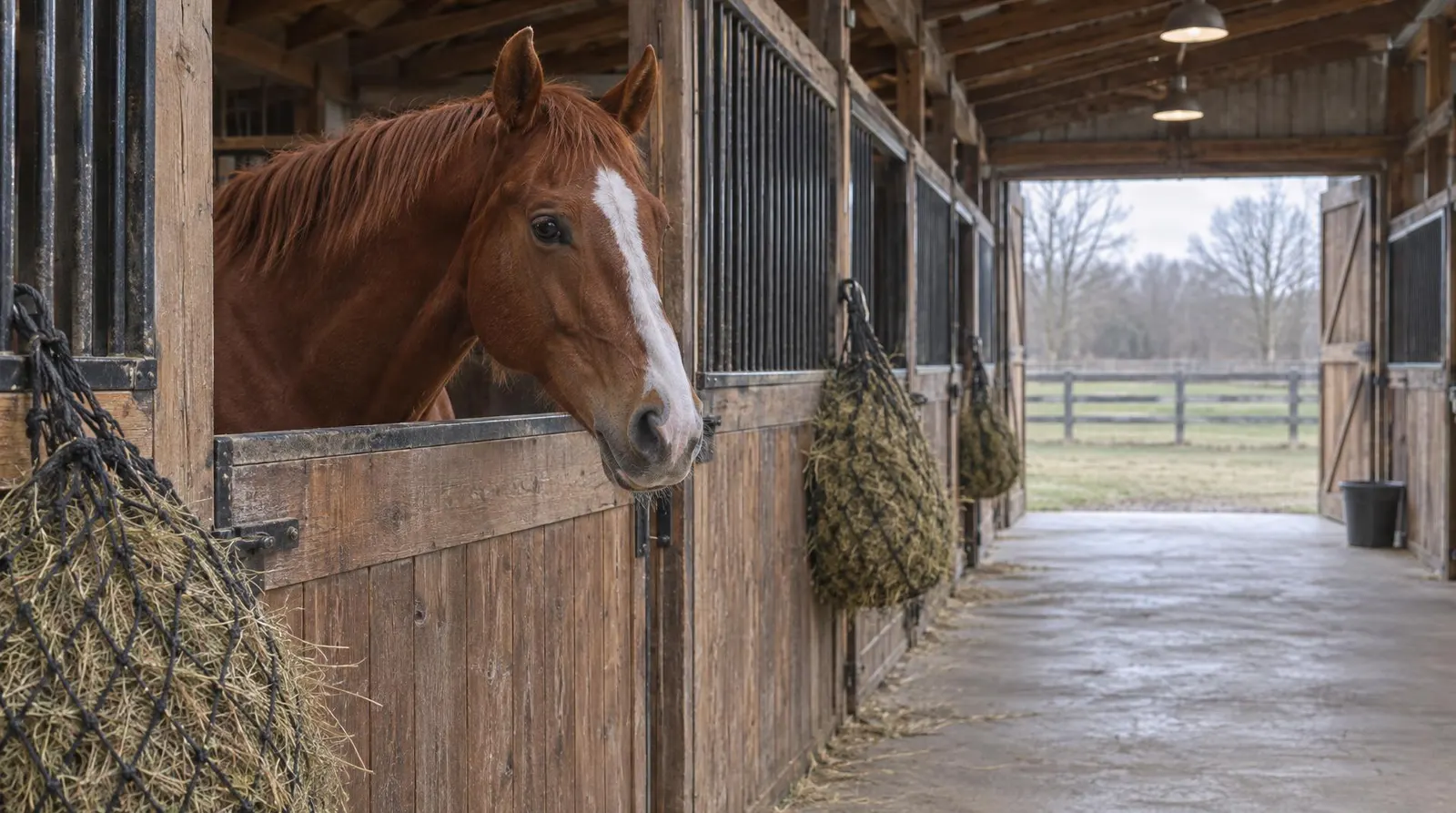
A peptide is a short chain of amino acids, and the three that horse owners ask about most (BPC-157, TB-500 and GHK-Cu) have been studied in rats, mice and cell cultures, not in horses. The horse papers that do exist are about detection: racing labs building tests to catch thymosin beta-4 products in urine and plasma, which tells you nothing about whether the peptide does anything.
What is a peptide, in plain terms?
A peptide is a chain of amino acids short enough that nobody calls it a protein. BPC-157 is 15 amino acids long, which is why papers call it a pentadecapeptide. GHK-Cu is three (glycine, histidine and lysine) carrying a copper ion. TB-500 is a trade name used for two different materials: a seven-amino-acid piece of thymosin beta-4 (Ac-LKKTETQ), and full-length thymosin beta-4 itself, all 43 amino acids. The certificate's CAS number tells you which one is in the vial.
Horses make thymosin beta-4 on their own. A 2026 plasma study of 49 Arabian and Thoroughbred racehorses found its level moved with the training phase (Grzedzicka et al., 2026, Equine Veterinary Journal).
Which peptides do horse owners ask about?
Three, over and over.
BPC-157 started as a stomach story. The papers name it a "gastric pentadecapeptide" (Gwyer et al., 2019, Cell and Tissue Research). Most of what owners hear about it comes from rat tendon, ligament and muscle work, and nearly all of that traces to one group in Zagreb. The full account is in what BPC-157 is and what has been studied in horses.
TB-500 is the one horse people mention with the most confidence and the least to point to. A 2012 horse-lab paper opens by noting that "a veterinary preparation known as TB-500" had emerged (Ho et al., 2012, Journal of Chromatography A). Its own page is what TB-500 is and why people use it on horses.
GHK-Cu comes out of skin research. In a rat wound-chamber model it increased connective tissue accumulation (Maquart et al., 1993, Journal of Clinical Investigation), and in irradiated rat skin flaps a topical gel made no difference to vessel number or VEGF expression (Parker et al., 2013, Otolaryngology-Head and Neck Surgery). We found no horse study of GHK-Cu at all. One thing a buyer can check by eye: the copper gives the powder a blue colour, which Pure Pet Peptide explains in why GHK-Cu powder is blue. Colour is a hint, never proof of identity.
How much of the research involves a horse?
Less than vendor pages suggest, and none of it measures recovery.
For BPC-157 and GHK-Cu, none. PubMed searches run on 2026-11-25 found no horse study of BPC-157 for effect, safety or pharmacokinetics, no horse doping-control paper on it, and no horse or large-animal efficacy study of GHK-Cu. The BPC-157 detection papers that exist use human samples: Tian et al., 2023, Molecules built a urine method, and Mazzarino et al., 2026, The Analyst put BPC-157 and TB-500 among 54 compounds in a blood-matrix method.
For TB-500 the horse papers are all chemistry. Ho and colleagues reported the first identification of TB-500 and its metabolites in post-administration horse samples. Kwok et al., 2013, Analytical and Bioanalytical Chemistry detected it in plasma from two Thoroughbred geldings. And Delcourt et al., 2025, Drug Testing and Analysis measured natural thymosin beta-4 in racing horses' blood, to give labs a baseline.
Everything about whether these peptides do anything is rodent or cell work. Staresinic et al., 2003, Journal of Orthopaedic Research used a rat Achilles transection model plus cultured tendon cells, and the peptide group recovered better than saline controls. The only study we found that put BPC-157 and TB-500 in the same animals is Bicer et al., 2026, Joint Diseases and Related Surgery: 32 rats with a repaired Achilles tendon, four groups. TB-500 had a significant biomechanical and histological edge, BPC-157 was numerically better but not significantly, and the pair did no better than either alone. The authors call it exploratory.
The thymosin beta-4 studies in rats and mice (skin wounds, and mouse heart attack models) used the full-length protein, not the seven-amino-acid fragment, so they can't be read as results for the fragment. A 2019 review found "the majority of studies have been performed on small rodent models" from "only a handful of research groups" (Gwyer et al., 2019, Cell and Tissue Research). A 2025 systematic review of BPC-157 in orthopaedic sports medicine counted 36 studies, 35 of them preclinical and one clinical (Vasireddi et al., 2025, HSS Journal).
Why do vendor guides disagree with each other?
Because they're filling a gap, and each one fills it differently. A guide that quotes a percentage improvement or a number of weeks in horses has to be quoting something, and the searches found no controlled horse study of efficacy for any of the three. Some guides also never say which TB-500 they mean, the fragment or the whole protein, and the two are different molecules.
The second reason is the vial. Nobody has published a purity analysis of BPC-157, TB-500 or GHK-Cu bought online; we searched and found none. The closest analogues are not reassuring. Researchers who bought semaglutide from online sellers with no prescription had three freeze-dried vials analysed, and all three were judged probable substandard or falsified, with measured purity of 7.7% to 14.37% against 99% claimed (Ashraf et al., 2024, Journal of Medical Internet Research). Different market and a different peptide, same lesson about labels.
The BPC-157 systematic review warns of "unregulated manufacturing, contamination, or unknown clinical safety", and racing labs report "numerous products available online" claiming to contain thymosin beta-4 or its fragment (Vasireddi and Delcourt, linked above). The research on these peptides is real. The vial is where it goes wrong.
What does the paperwork on a vial tell you?
It tells you whether the thing in your hand is the thing on the label, which is the one question you can settle before it goes anywhere near a horse. A certificate of analysis names the lab, the method, the compound, the lot, the measured amount and the purity. The lot has to match the vial, and the report should be checkable at the lab's own site. The steps are laid out in how to read a peptide COA and how to tell if peptides are real, and Pure Pet Peptide's own explainers cover how to read a certificate of analysis and what third-party testing shows.
A report is still only a report. It can't tell you what a peptide does in a horse, because nobody has run that study.
Here is what passing the check looks like. Pure Pet Peptide has its lots tested by two US labs, Horizon Analytical (UPLC/MS) and Vanguard Laboratory (HPLC-UV/VIS), and every vial carries a QR code that opens the report for that lot. Lot HZ98, a 5 mg BPC-157 vial, sits on Horizon report 1028861 with a measured 4.95 mg and a printed purity of 99.36%. Its TB-500 is full-length thymosin beta-4 (CAS 77591-33-4) on its Horizon certificates, which is the form the rodent thymosin beta-4 work used. You can look up reports on its lot verification page and quality page, and the store listing is on where to buy.
What should a vet be part of?
The diagnosis and the rehab plan, whatever you decide about a peptide. Tendon and suspensory injuries in horses are slow and uncertain on any path. A study of 127 National Hunt racehorses with superficial digital flexor tendon injury found return to racing was not associated with treatment choice, and controlled exercise alone did as well as the other options studied, including platelet-rich plasma (Witte et al., 2016, The Veterinary Journal).
No peptide paper changes those numbers, because no peptide paper includes a horse. If you're weighing a peptide on top of a rehab plan, your vet is the person who knows what the leg looks like.
What should owners who compete know first?
That labs are looking. Delcourt and colleagues state that thymosin beta-4 is not authorised as a medicine and is forbidden by the IFHA, the FEI and WADA. Racing labs already screen horse plasma for these peptides (Kwok, above), and BPC-157 and TB-500 are both among the 54 compounds in a 2026 anti-doping blood method (Mazzarino, above). We did not find a published horse test for BPC-157 specifically, and we can't say how long any of them stays detectable.
Rule books change, so read the current prohibited list for your discipline. The rules side is in are peptides legal for horses, and the testing side is in can a horse test positive for peptides.
Before you buy anything, read the lot number off the vial and look its report up at the lab's own verify page.
FAQ
Is TB-500 detectable in horses?
Yes. Hong Kong Jockey Club chemists published a method that confirmed TB-500 and its metabolites in horse urine and plasma, and a French lab has since published a strategy for telling natural thymosin beta-4 from misuse. How long it stays detectable is not something we found published.
Is BPC-157 or TB-500 better for tendon injuries?
Nobody can say for horses. In the one rat Achilles study that tested both, TB-500 showed the clearer advantage and BPC-157 did not reach significance, and the authors called the work exploratory.
Does BPC-157 plus TB-500 work better than either alone?
In that same rat study, the combination added nothing over either peptide alone. There is no horse data on the pair.
How do we know if a certificate of analysis is real?
Match the lot number on the vial to the report, then confirm the report number at the lab's own verification page, not the seller's. A report you can't confirm with the lab that issued it is a picture of a report.
Sources
- Bicer et al., 2026. Effects of BPC-157 and TB-500 on Achilles tendon healing in rats: A histopathological and biomechanical study. Joint Diseases and Related Surgery.
- Vasireddi et al., 2025. Emerging Use of BPC-157 in Orthopaedic Sports Medicine: A Systematic Review. HSS Journal.
- Gwyer et al., 2019. Gastric pentadecapeptide body protection compound BPC 157 and its role in accelerating musculoskeletal soft tissue healing. Cell and Tissue Research.
- Ho et al., 2012. Doping control analysis of TB-500, a synthetic version of an active region of thymosin beta4, in equine urine and plasma by liquid chromatography-mass spectrometry. Journal of Chromatography A.
- Kwok et al., 2013. Doping control analysis of seven bioactive peptides in horse plasma by liquid chromatography-mass spectrometry. Analytical and Bioanalytical Chemistry.
- Delcourt et al., 2025. Equine Doping Controls of Thymosin beta4: A Population Study and Strategy for Misuse Detection. Drug Testing and Analysis.
- Ashraf et al., 2024. Multifactor Quality and Safety Analysis of Semaglutide Products Sold by Online Sellers Without a Prescription. Journal of Medical Internet Research.
- Horizon Analytical. Certificate of analysis verification.
Read next
Are peptides legal for horses?
No peptide such as BPC-157, TB-500 or GHK-Cu has an FDA animal drug approval. Whether a horse may carry one depends mostly on whether it competes.
BPC-157 or TB-500 for a horse's tendon: which has more research?
By the published record TB-500 and thymosin beta-4 have the broader research base, and the one rat tendon head-to-head favoured TB-500. No horse trial exists.

Can a horse test positive for TB-500 or BPC-157?
Yes for TB-500 and thymosin beta-4: racing labs have detected them in horse urine and plasma since 2012. No horse test for BPC-157 has been published.