How do you read a peptide certificate of analysis before buying for a horse?
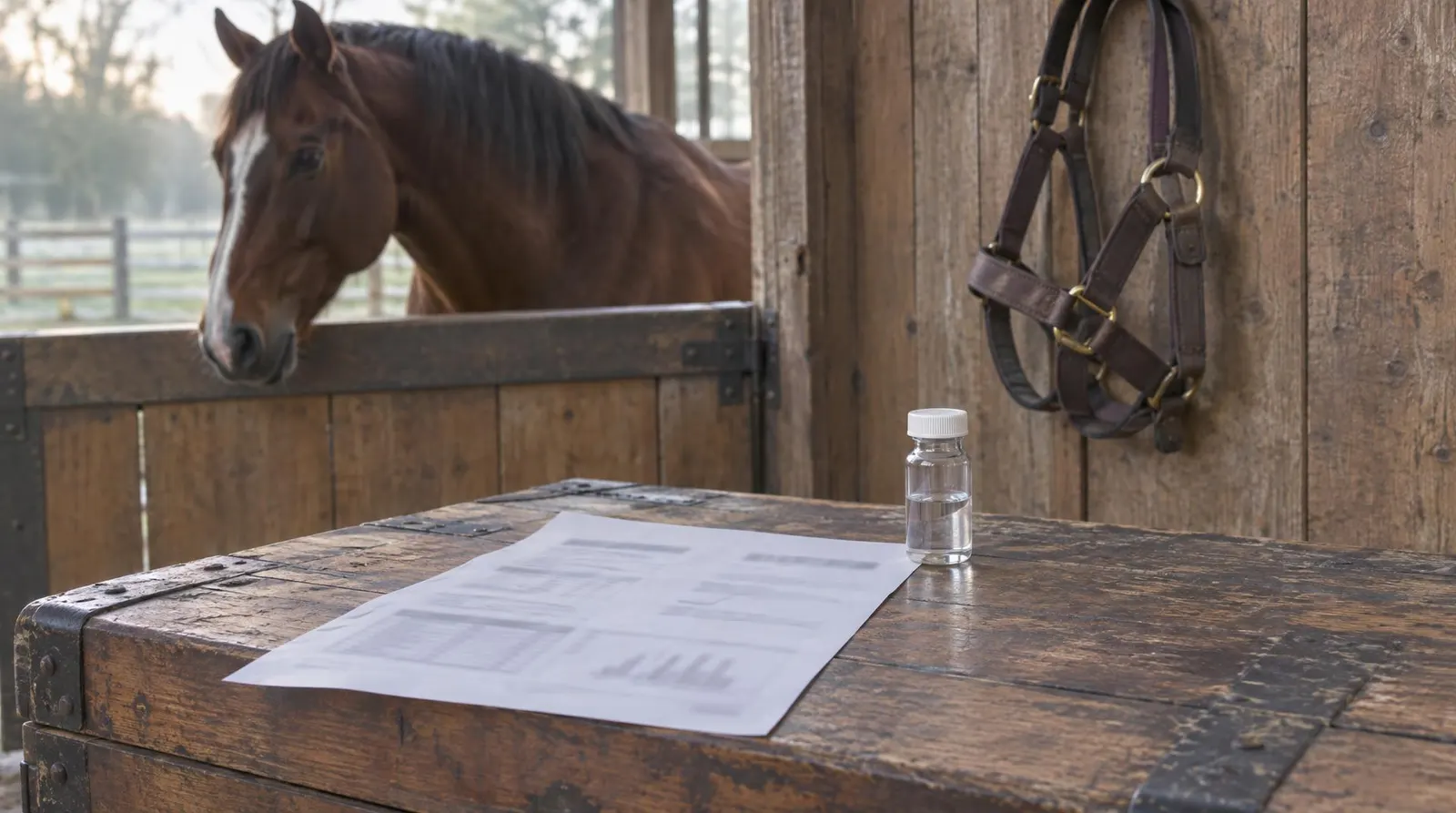
Read five lines in order: who ran the test, the lot number, the identity result and its method, the purity percentage, and the measured quantity against the label. Then take the report number to the lab that issued it and see whether its own record agrees.
The example below is a real certificate: Pure Pet Peptide lot SM46, Horizon Analytical report 1028841, the TB-500 line. That blend size isn't currently sold. It is the published TB-500 line on a Horizon report, and it's a good one to practice on.
Who should have run the test?
A named laboratory that isn't hiding behind the seller's logo, with a way to contact it and a way to look the report up. Pure Pet Peptide's two labs are Horizon Analytical, which runs UPLC/MS, and Vanguard Laboratory, which runs HPLC-UV/VIS. Both publish a place to check a report: Horizon's verify page and the Verified by Vanguard hub.
Ask whether the lab states an accreditation, and check any claim at the accrediting body's own register. Vanguard's site describes its results as ISO/IEC 17025:2017 accredited work. This page didn't check that against a register for either lab, so treat it as the lab's own statement.
Which lot does the certificate cover?
One batch. SM46 is the lot, the lab analyzed it on 2026-09-16, and the store lists the product as a 10 mg / 10 mg BPC-157 and TB-500 blend. Your vial's lot has to match the certificate's lot, character by character. A sheet with no lot number, or one reused across lots, tells you about nothing in particular, which is what Pure Pet Peptide's own explainer says too.
There's a wrinkle in the store's table. Report 1028841 sits against two lots, SM46 and HMTK, and report 1028861 against two others. A report naming several lots can be legitimate. What you'd put to the lab is which lot numbers its record names, and which line belongs to the lot in your hand. For lot SM46 the line to read is TB-500.
What does the identity line prove?
That the compound the lab measured is the compound on the label, by mass. Bachem, a peptide manufacturer, says "The molecular weight is determined by mass spectrometry," and a 2023 Pharmaceutical Research paper on reference standards used LC-MS/MS to confirm a peptide's mass and verify its sequence (McCarthy et al., 2023). The certificate should name the method, which here is UPLC/MS, and show the result, not a bare "pass."
For TB-500 the CAS number is the quick test. Full-length thymosin beta-4 is CAS 77591-33-4, a 43-amino-acid protein of about 4963 g/mol. Some of what is sold as TB-500 is something else: chemists at Ghent University analysed a commercial TB-500 product and found the N-terminal acetylated seven-amino-acid fragment Ac-LKKTETQ (Esposito et al., 2012, Drug Testing and Analysis). A fragment that small reads far below 4963 g/mol, so a different CAS number or a mass nowhere near it means a different molecule.
The store says its TB-500 is the full-length protein, CAS 77591-33-4, on its Horizon UPLC/MS certificates, and not the fragment. The rodent research on thymosin beta-4 used the full protein, which is laid out in what TB-500 is. You can read the CAS line and the observed mass on the certificate yourself.
What does the purity number mean?
The share of the signal that belongs to the main compound. Bachem: "the area of the main peak in relation to the total area of all peaks reflects the peptide purity." Lot SM46's TB-500 line prints 99.61%.
That number is relative to the other peaks the instrument saw. It doesn't tell you what the powder weighs or whether the main peak is the right molecule, which is why the identity line comes first. It also isn't a score to chase. The store's five lots print 99.36%, 99.45%, 99.61% and above 99.80%, so the figures differ lot to lot, as measurements of different batches would. A seller whose every product reads exactly 100, or identical to the decimal across lots, owes you an explanation. In the MIT Technology Review account of one lab's BPC-157 testing, purity across 64 vendors ran from about 82% to 100%.
Why check the measured milligrams?
Because purity and content are separate tests. Bachem: "NPC and purity are not equivalent, because the former includes peptidic contaminants." McCarthy et al. list the strength of a vial as its own assay. A freeze-dried vial also holds water and counter-ions that purity leaves out, so 99 percent pure can still be short of the labeled quantity.
Lot SM46's TB-500 line is labeled 10 mg and measured 9.95 mg, which is 99.5 percent of the label. No published tolerance is quoted here, so ask the seller what range it works to. The point is that the number is printed at all. A certificate with no measured quantity makes you take the label on faith, and that gap is where the online-seller studies found trouble: in a 2024 test of three semaglutide vials, content ran above the label while purity sat between 7.7% and 14.37% (Ashraf et al., 2024).
What does a recycled or forged certificate look like?
It has no lot number, or a lot that differs from your vial. It carries a bare "pass" with no method and no trace. The lab can't be found, or has no lookup, or the report number returns nothing. The same sheet turns up under several products. Any one of those and you're reading a document that can't be matched to your vial.
A PDF is easy to forward. Vanguard's page says as much: "A screenshot is easy to forward." That's the reason for the last step. Type the report number into the lab's own site and compare the lab, compound, lot and results with what the seller sent. This page didn't submit a real report number at either lab, so it can't describe what the result screen shows. Run the lookup yourself.
The store's own lot table lists every lot with its report number, and every vial carries a QR code that opens the certificate for its lot. Pure Pet Peptide's TB-500 is where the full-length product lives, and where to buy covers ordering. For the broader test of any seller, see how to tell if the peptides you bought are real.
What can a certificate never prove?
Anything it doesn't list. A certificate describes the powder in one lot on the day it was analyzed. It doesn't show sterility or endotoxin, which are separate tests and aren't on these certificates unless they're printed on them. A missing line says nothing either way. Horizon lists endotoxin testing as a service apart from purity, identity and quantitation, and MIT Technology Review reported that 8% of all the peptide samples one commercial lab tested had measurable endotoxins. Ashraf found endotoxin in all three of its vials.
Pure Pet Peptide describes its testing as identity and purity by US labs, and this page makes no claim about endotoxin or sterility for any of its lots. If you need that answer, ask for a report that names the test.
A certificate also says nothing about how a horse responds. If the horse competes, can a horse test positive for peptides? covers the rule side, and the testing hub collects the rest.
Next time you open a certificate, find the CAS number before anything else.
FAQ
What does CAS 77591-33-4 on a TB-500 certificate mean?
It is the registry number for full-length thymosin beta-4. A certificate that names TB-500 but prints a different CAS number, or none, hasn't told you which molecule you have. Check it against the mass on the identity line.
Is a higher purity percentage always better?
No. Purity compares the main peak with the other peaks, and it can't tell you the compound or the quantity in the vial. A 99.6 with a matching identity line and a measured amount beside it is more useful than a 99.9 with neither.
Can one report cover more than one lot?
It can, and some do. Ask the lab which lot numbers its record names, and check that the line you are reading belongs to your lot. A report that names none of your lot numbers doesn't describe your vial.
What if the certificate lists only "TB-500" and a purity?
It has skipped the line that matters. Ask the seller for the identity result, the CAS number and the measured quantity for your lot, and for the report number so you can confirm it at the lab.
Sources
- McCarthy et al., 2023. Reference Standards to Support Quality of Synthetic Peptide Therapeutics. Pharmaceutical Research.
- Esposito et al., 2012. Synthesis and characterization of the N-terminal acetylated 17-23 fragment of thymosin beta 4 identified in TB-500. Drug Testing and Analysis.
- Ashraf et al., 2024. Multifactor Quality and Safety Analysis of Semaglutide Products Sold by Online Sellers Without a Prescription. Journal of Medical Internet Research.
- Bachem. Quality Control of Amino Acids and Peptides: A Guide.
- Willyard, 2026. Peptides are everywhere. Here's what you need to know. MIT Technology Review, a report on one commercial lab's peptide testing data.
- Horizon Analytical. Verify Certificate of Analysis, the lab's report lookup.
- Vanguard Laboratory. Verified by Vanguard reporting hub, a lab-hosted record search by brand and report date.
Read next
How can you tell if the peptides you bought are real?
Not from the vial. Match its lot number to a named lab's certificate, read the identity, purity and measured-amount lines, then confirm the report at the lab.

Are peptides legal for horses?
No peptide such as BPC-157, TB-500 or GHK-Cu has an FDA animal drug approval. Whether a horse may carry one depends mostly on whether it competes.

BPC-157 or TB-500 for a horse's tendon: which has more research?
By the published record TB-500 and thymosin beta-4 have the broader research base, and the one rat tendon head-to-head favoured TB-500. No horse trial exists.