What is BPC-157, and what has been studied in horses?
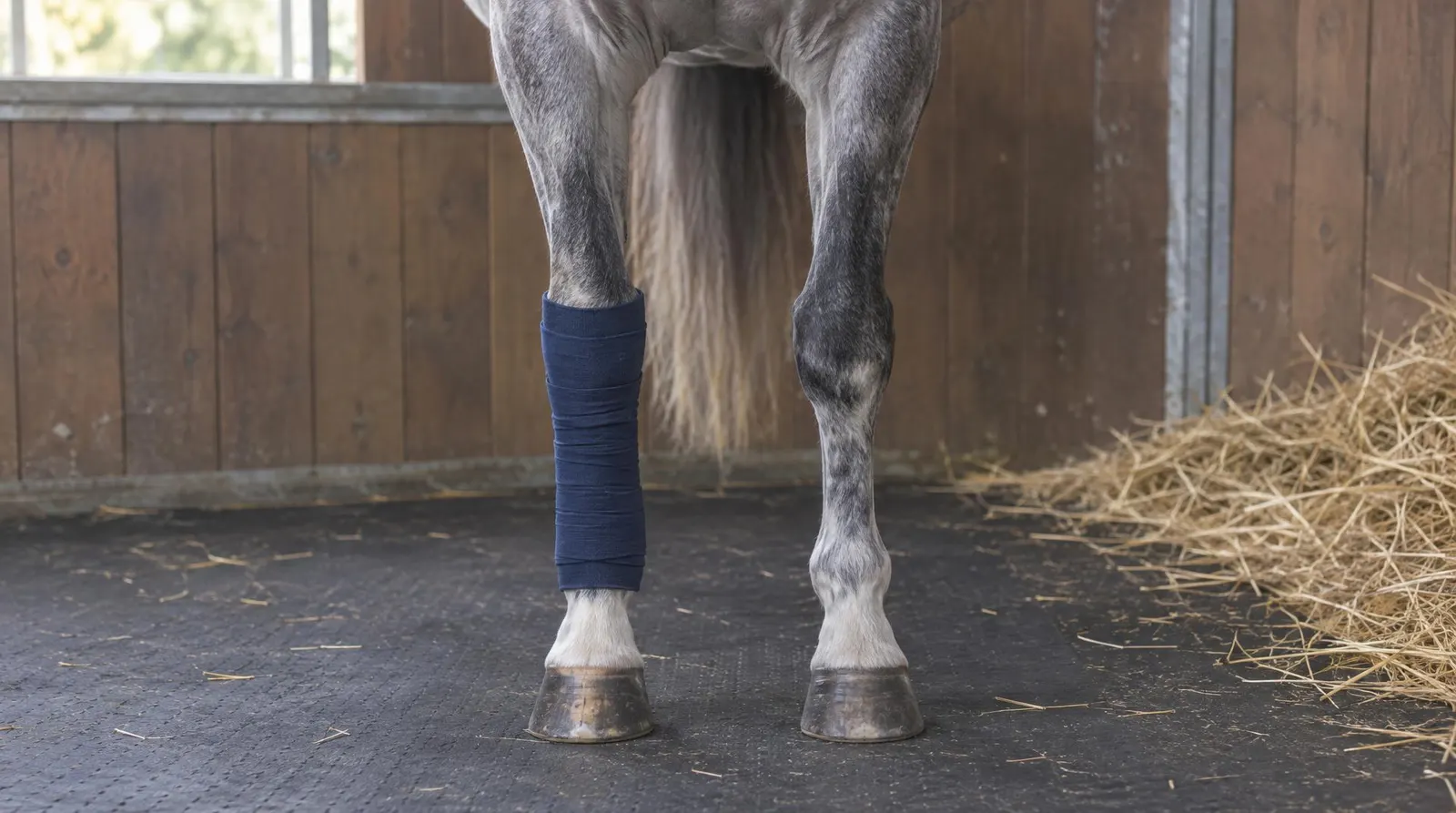
No published study has given BPC-157 to a horse. What exists is rat tendon and muscle work plus cell studies, much of it from one research group in Zagreb, with further work from groups in Taiwan and Turkey.
Where does BPC-157 come from?
It began as a gastric peptide, and the name tells you so. BPC stands for body protection compound, and the papers call it a "gastric pentadecapeptide": a chain of 15 amino acids (Gwyer et al., 2019, Cell and Tissue Research). The Zagreb group that originated it, with Sikiric as senior author on the 2003 tendon paper, wrote most of the animal studies below.
Anything you read about it in horses starts from the rodent literature, so that is where this page starts too. The wider picture across three peptides is in what peptides for horses are and what the research shows.
What do the tendon and ligament studies show, and in which animals?
Every animal study below is a rat. Each is named with its model, because "tendon study" hides a lot.
- Staresinic et al., 2003, Journal of Orthopaedic Research: rat Achilles tendon transection, plus cultured tendon cells. The peptide group had better biomechanical, functional and microscopic recovery than saline controls.
- Krivic et al., 2006, Journal of Orthopaedic Research: rat Achilles tendon-to-bone detachment. The peptide group showed better healing, and the setback caused by a corticosteroid was smaller.
- Staresinic et al., 2006, Journal of Orthopaedic Research: rat quadriceps muscle transection, where the peptide group did better on biomechanical, functional and microscopic recovery over the follow-up.
- Novinscak et al., 2008, Surgery Today: rat gastrocnemius crush injury, with less hematoma and edema.
- Brcic et al., 2009, Journal of Physiology and Pharmacology: rat crushed muscle, transected muscle and tendon, plus cell culture. There was no direct effect on blood vessel growth in culture, but in injured rat tissue VEGF expression was modulated.
- Chang et al., 2011, Journal of Applied Physiology: rat tendon explants and cultured tendon fibroblasts. More cells grew out of the explants, survived stress and migrated, and cell proliferation itself did not rise directly.
Ligament work is covered by the 2019 review, not by a named study here. And the finding that sticks with us is the last one. In cell culture the peptide moved and protected tendon cells without making more of them.
Is there any horse-specific research?
No. We searched PubMed on 2026-11-25 for BPC-157 together with horse, equine and racehorse, and the combination of BPC 157 with the MeSH term for horses returned zero results. No equine efficacy, safety or pharmacokinetic study turned up. No horse doping-control paper either.
The doping papers that exist use human samples. Tian et al., 2023, Molecules built a urine method and described in vitro metabolites. Mazzarino et al., 2026, The Analyst includes BPC-157 among 54 compounds in a blood-matrix method. PubMed isn't the whole world, and we did not search conference abstracts or lab bulletins, so a horse paper outside PubMed isn't ruled out.
Human evidence is thin too. A 2025 systematic review found 544 articles from 1993 to 2024 and kept 36: 35 preclinical studies and 1 clinical study. It found no clinical safety data and warned of "unregulated manufacturing, contamination, or unknown clinical safety" (Vasireddi et al., 2025, HSS Journal).
Who did the research, and does that matter?
It matters, because most of it comes from one place. The 2003 to 2009 studies above, and a 2025 review arguing the peptide's "efficacy and pleiotropic beneficial effects" and "high safety" (Sikiric et al., 2025, Pharmaceuticals), are from the Zagreb group that originated the peptide. That review is the originators making their case, so weigh it that way.
The work from outside Zagreb is smaller. A Taiwanese group at Chang Gung University ran the 2011 explant study and a 2014 follow-up showing the peptide raised growth hormone receptor expression in rat tendon fibroblasts (Chang et al., 2014, Molecules). Both are cell work. A Turkish group put BPC-157 and TB-500 in 32 rats with a repaired Achilles tendon, four groups (Bicer et al., 2026, Joint Diseases and Related Surgery). TB-500 had a significant biomechanical and histological advantage. BPC-157 was numerically better but not significant on total scores, and the combination added nothing over either alone. The authors call the study exploratory.
So the one animal-level result from outside the originating group is a mixed one. The 2019 review says the same thing in general terms: the majority of studies are on "small rodent models" and "only a handful of research groups" have done in-depth work. That is a reason to hold any firm claim about BPC-157 loosely.
If you're buying BPC-157 for any purpose, the thing you can check today is the vial. Pure Pet Peptide sells BPC-157 in 5 mg and 10 mg sizes, and its published lots can be looked up on the store's lot verification page. Lot HZ98 (5 mg) is on Horizon Analytical report 1028861 with 4.95 mg measured and a printed purity of 99.36%. Lot HMTK (10 mg) is on report 1028841 with 9.95 mg measured and a purity of 99.45%. Both were analysed on 2026-09-16 by UPLC/MS. The method for reading such a report is in how to read a peptide COA, and where to find the store is on where to buy.
Why do horse people care about its gut origin?
Because two things sit next to each other in people's heads: a peptide first described in a gastric context, and a horse population with a lot of stomach ulcers. No study joins them. We found no horse gastric ulcer study of BPC-157, and nothing on this page suggests it affects ulcers in a horse.
What the research does say is narrower. A 2025 commentary describes BPC-157 as a natural pentadecapeptide "believed to protect the gastro-intestinal tract", and it discusses a 2024 review by Sikiric and 21 co-authors, which we did not open (Whitehouse, 2025, Inflammopharmacology). We could not source a primary gut-lining study to name here.
The horse side is better documented. Equine gastric ulcer syndrome is split into squamous and glandular disease by a European consensus statement, as summarised in Vokes et al., 2023, Animals. By endoscopy, ulceration was found in 87% of 224 Standardbred racehorses in training (Rabuffo et al., 2002, JAVMA), 58% of 50 show horses (McClure et al., 1999, JAVMA) and 67% of horses examined after endurance rides, in a preliminary report (Nieto et al., 2004, The Veterinary Journal). Each figure belongs to its own population. Your vet is the one who scopes a horse and decides what it needs.
Is BPC-157 allowed in competition?
That depends on the body running your event, and the rules have their own page: are peptides legal for horses. We state no rule detail here on purpose, because rule books get revised and a summary on a research page goes stale. Read that page, then read your discipline's current list.
The search for a horse study of BPC-157 was run on 2026-11-25, so a paper published after that date is newer than this page.
FAQ
Does BPC-157 plus TB-500 work better than either alone?
In the one rat Achilles study that tested both together, it did not: the combination added nothing over either peptide alone. There is no horse data on the pair. The comparison is laid out in BPC-157 or TB-500 for a horse tendon injury.
Is BPC-157 or TB-500 better for tendon injuries?
Nobody can say for horses. In the Turkish rat study, TB-500 had the clearer advantage and BPC-157 did not reach significance on total scores. The authors called it exploratory, so it is one small study.
What is known about BPC-157 safety?
The systematic review found no clinical safety data. The originating group argues for a high safety margin, based on animal and cell work, and that is the group with the most at stake in the answer. No horse safety study exists in what we could find. More on how TB-500 compares is in what TB-500 is and why people use it on horses.
How do we know if a certificate of analysis is real?
Match the lot number on the vial to the report, then confirm the report number at the lab's own verification page rather than the seller's. Pure Pet Peptide explains the steps in how to read a peptide certificate of analysis.
Sources
- Gwyer et al., 2019. Gastric pentadecapeptide body protection compound BPC 157 and its role in accelerating musculoskeletal soft tissue healing. Cell and Tissue Research.
- Vasireddi et al., 2025. Emerging Use of BPC-157 in Orthopaedic Sports Medicine: A Systematic Review. HSS Journal.
- Staresinic et al., 2003. Gastric pentadecapeptide BPC 157 accelerates healing of transected rat Achilles tendon and in vitro stimulates tendocytes growth. Journal of Orthopaedic Research.
- Krivic et al., 2006. Achilles detachment in rat and stable gastric pentadecapeptide BPC 157: Promoted tendon-to-bone healing and opposed corticosteroid aggravation. Journal of Orthopaedic Research.
- Chang et al., 2011. The promoting effect of pentadecapeptide BPC 157 on tendon healing involves tendon outgrowth, cell survival, and cell migration. Journal of Applied Physiology.
- Bicer et al., 2026. Effects of BPC-157 and TB-500 on Achilles tendon healing in rats: A histopathological and biomechanical study. Joint Diseases and Related Surgery.
- Sikiric et al., 2025. Stable Gastric Pentadecapeptide BPC 157 as a Therapy and Safety Key: A Special Beneficial Pleiotropic Effect Controlling and Modulating Angiogenesis and the NO-System. Pharmaceuticals.
- Tian et al., 2023. Stable Isotope Labeling-Based Nontargeted Strategy for Characterization of the In Vitro Metabolic Profile of a Novel Doping BPC-157 in Doping Control by UHPLC-HRMS. Molecules.
- Mazzarino et al., 2026. Rapid and harmonized analytical workflow for the determination of peptidic and non-peptidic doping agents in dried and liquid blood matrices. The Analyst.
- Whitehouse, 2025. Concerning BPC-157, a natural pentadecapeptide. Inflammopharmacology.
Read next
BPC-157 or TB-500 for a horse's tendon: which has more research?
By the published record TB-500 and thymosin beta-4 have the broader research base, and the one rat tendon head-to-head favoured TB-500. No horse trial exists.

What is TB-500, and why do horse owners use it?
TB-500 is sold as synthetic thymosin beta-4 or a short fragment of it. What the research covers, what exists in horses, and how to tell which you have.

Are peptides legal for horses?
No peptide such as BPC-157, TB-500 or GHK-Cu has an FDA animal drug approval. Whether a horse may carry one depends mostly on whether it competes.